 Skip-the-line available
What is actually on the walls at Chauvet 2
Lions, rhinos, bears and a leopard — an Ice Age menagerie weighted towards predators, which is what makes Chauvet strange.
Most Ice Age cave art is about the animals people ate. Chauvet is largely about the animals that could eat them. That single difference is why the cave matters to specialists and why the hour inside the reconstruction does not feel like a museum walk-through.
The Panel of the Lions
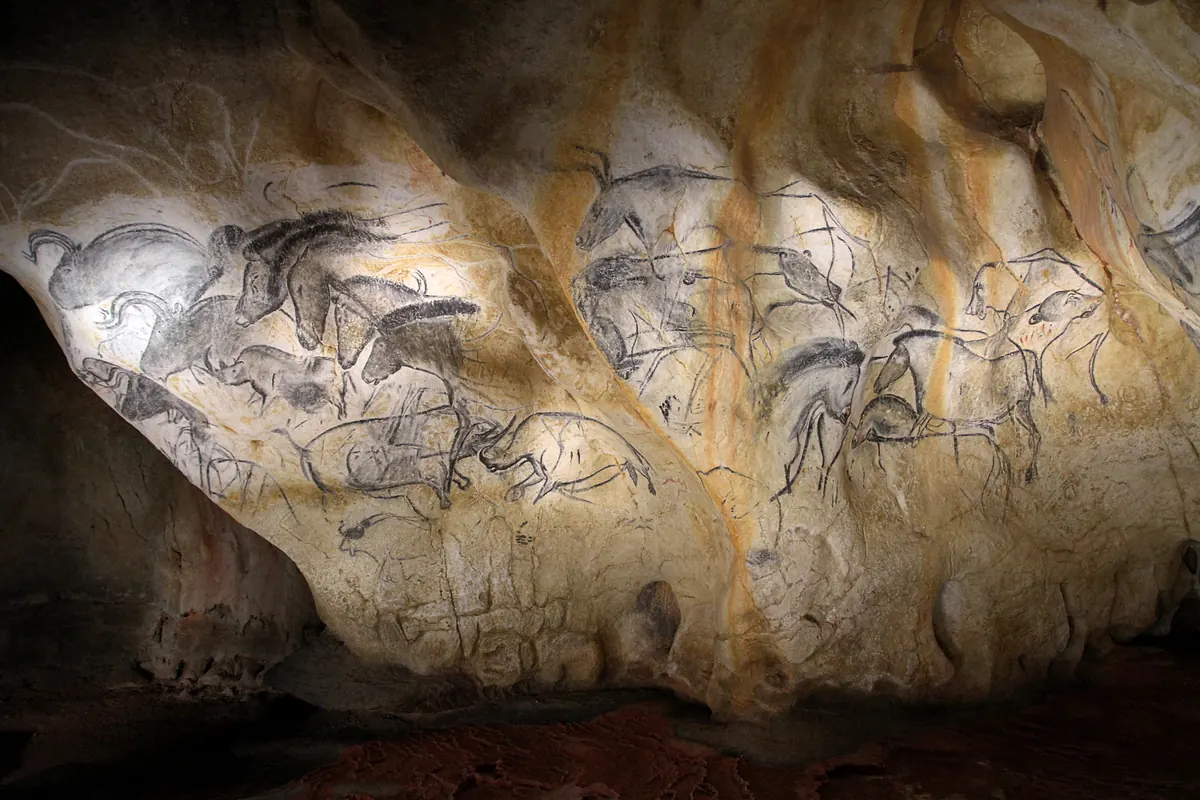
The best-known wall is a hunting scene: a pride of cave lions, ears flattened, moving as a group towards a herd of bison. It is drawn in charcoal with shading and perspective that were not supposed to exist for another thirty thousand years. Rhinoceroses appear alongside, some in what reads as motion. Whatever else the panel is, it is observed — these are animals someone had watched closely enough to know how they behave when they are hunting.
The Panel of the Horses
Four horse heads in charcoal, one above the other, each with a different set to the ears and mouth. Below and around them are aurochs and rhinos, some engraved into the wall rather than drawn on it. The artist used the natural curve of the rock to give the heads depth, and scraped the surface clean first so the charcoal would sit brighter. It is the panel most often reproduced in books, and it is larger in person than photographs suggest.
Bears, bones and handprints
The floor of the original was littered with cave bear remains — skulls, scattered bones, and the shallow hollows where bears slept. The reconstruction carries these across, including a bear skull placed on a fallen block in the position the excavators recorded. On the walls there are handprints: some negative, made by blowing pigment around a hand, some positive, pressed on with a palm dipped in red ochre. One has a bent little finger, and it recurs, which means you can follow one individual through the cave.
The gallery and the 360° room
Your ticket also covers the Galerie de l'Aurignacien, which sets out who these people were, what the climate was like, and which animals shared the valley with them, with life-size reconstructions and excavated material. There is a 360° sound-and-light room that puts you inside the landscape of the period. Most visitors budget for the cave and then find the gallery takes another hour; the operator's recommended three and a half hours on site is not padding.
Frequently asked
How many animals are there?
Hundreds of figures have been catalogued in the original cave, across at least thirteen species — an unusually high proportion of them predators.
Can I photograph the panels?
Photography without flash is generally allowed inside the reconstruction. Follow the signage on the day, since rules can change for events.
Is it frightening for children?
It is dark and quiet rather than frightening. Most children over five are comfortable; under-fives sometimes find the hush difficult.