 Skip-the-line available
Why you cannot visit the original Chauvet cave
Found in 1994, sealed within weeks, and inscribed by UNESCO twenty years later — the original has never admitted the public.
People arrive at Grotte Chauvet 2 expecting a visitor centre attached to a real cave. It is not that. The original Chauvet cave is a few kilometres away, sealed, and it has never been open to the public for a single day since it was found. Understanding why explains what you are actually looking at in the Ardèche, and why a reconstruction is not a consolation prize here.
Found in December 1994
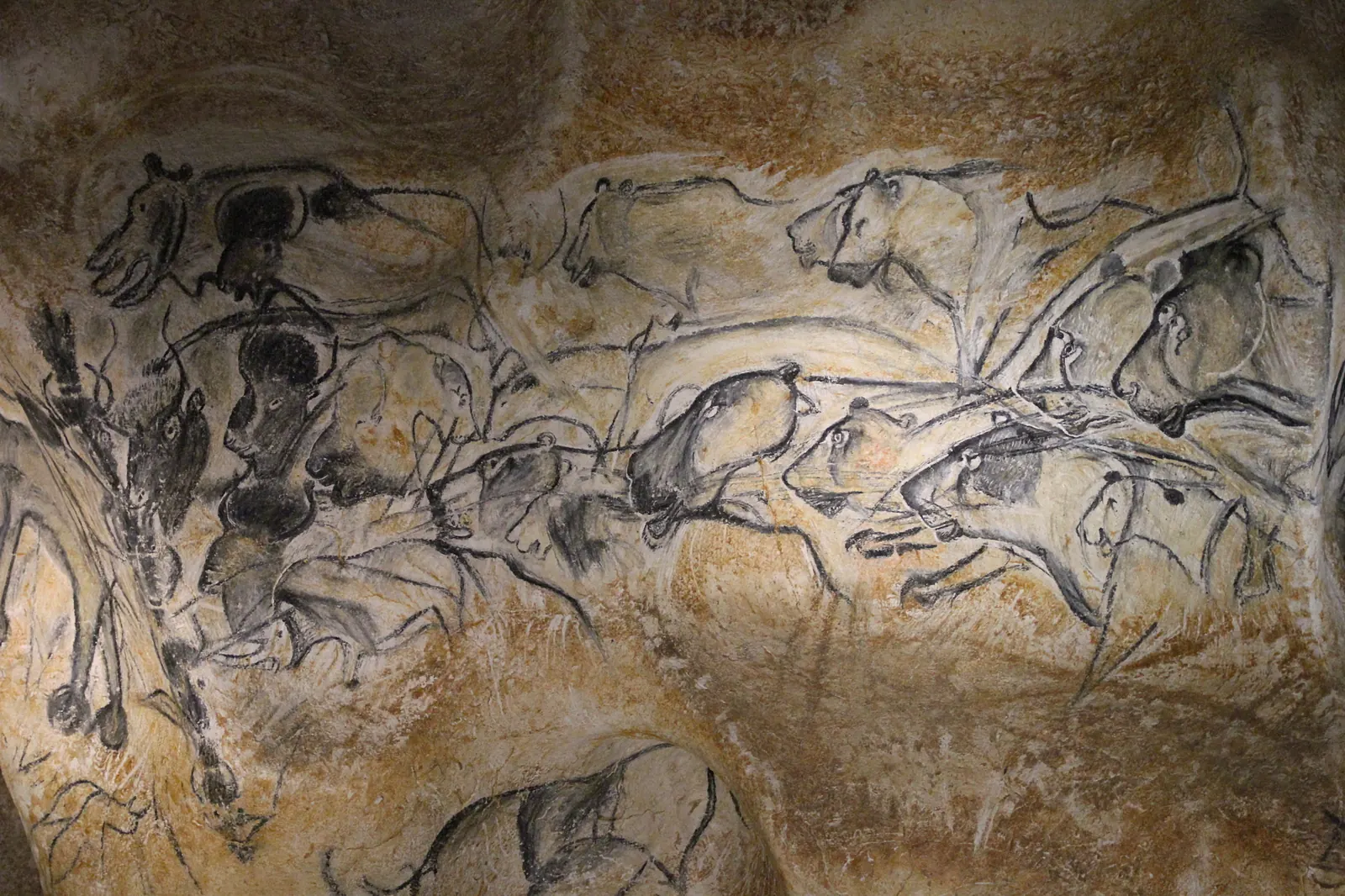
On 18 December 1994 three cavers — Jean-Marie Chauvet, Éliette Brunel-Deschamps and Christian Hillaire — followed a draught of air through a narrow opening in a cliff above the Ardèche gorge and dropped into a chamber no one had entered for tens of thousands of years. Bear hollows were still pressed into the floor. Hundreds of animals were drawn on the walls in charcoal and red ochre, in a state of preservation that had no real precedent. The significance was obvious within days, and so was the risk.
The lesson of Lascaux
France had already learned what visitors do to a painted cave. Lascaux opened to the public in 1948, drew enormous crowds, and within fifteen years the paintings were being attacked by algae and calcite driven by the carbon dioxide, heat and humidity that human bodies bring underground. It closed in 1963. The damage was not reversible. When Chauvet was found, that history was recent enough that closure was never seriously in question, and the cave was sealed almost immediately under state protection.
UNESCO, and still closed
The original cave was inscribed on the UNESCO World Heritage List on 22 June 2014. Inscription recognises the site's value; it does not open the door. Access remains restricted to a small number of researchers working short sessions under strict conditions, and there is no plan to admit visitors. The listing belongs to the sealed cave, not to the reconstruction — a distinction worth holding on to when you read marketing that blurs the two.
What the reconstruction actually is
Grotte Chauvet 2 opened on 25 April 2015, originally as the Caverne du Pont-d'Arc, about ten kilometres from the original. The painted chambers were reproduced at full size across 8,180 m² of moulded rock, which makes it the largest decorated cave replica in the world, from laser surveys rather than from freehand copying. The point is not that it imitates the cave; it is that the geometry, the scale and the awkwardness of the original surfaces are carried across, so a lion drawn around a bulge in the rock still bends around that bulge.
Frequently asked
Will the original ever open?
There is no plan to open it and every conservation argument runs the other way. Treat it as permanently closed.
Is the replica UNESCO-listed?
No. The 2014 inscription applies to the original sealed cave. The replica is a separate, modern site.
How close is the replica to the real cave?
About ten kilometres, both above Vallon-Pont-d'Arc. You cannot visit or see the original entrance.